
Case Study
Multi-Project Real Estate Marketing Platform
A real estate broker launching developer campaigns faced a repeating cost: every new project traditionally meant another website — duplicated engineering, inconsistent branding, repeated SEO work, and expensive maintenance. The solution was a reusable marketing platform capable of powering multiple campaign sites from one foundation, each with its own domain, identity, and analytics.
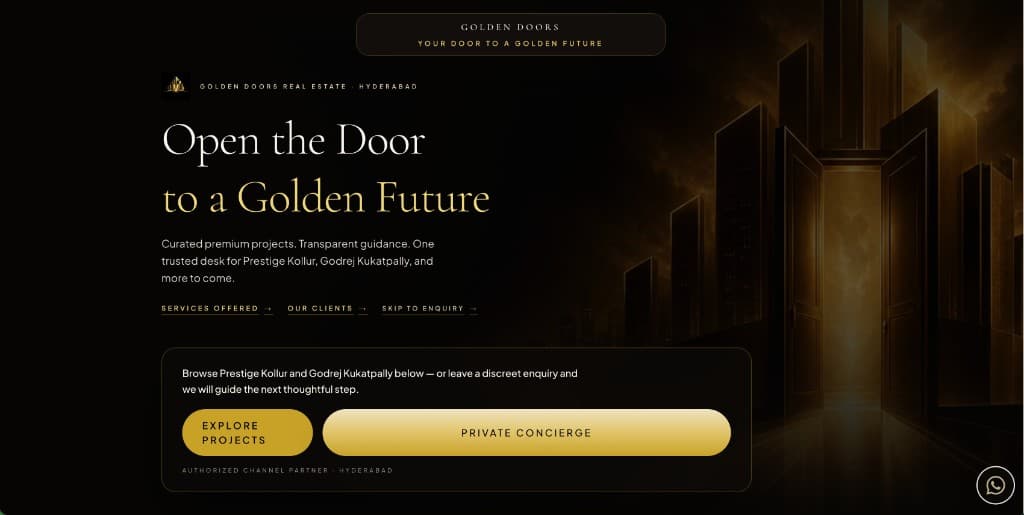
The broker hub as central entry point
The broker hub acts as the central entry point for multiple real estate campaigns — routing visitors to live developer microsites without collapsing distinct brands under one domain.
Project Overview
Project Overview
Real estate brokerage at this scale is a series of launches, not a static catalog. Each developer campaign needs its own marketing surface — hero narrative, pricing collateral, location story, enquiry capture, legal disclosure — optimized for conversion and search. The client already operated multiple projects and needed architecture that could grow beyond the first site. The platform prioritizes repeatability over one-off implementation. Campaigns such as Prestige and Godrej feel independent to visitors — separate domains, separate analytics, separate developer branding — while engineers maintain one shared foundation underneath.
My Role
My Role
Sole Engineer — platform architecture, shared section system, multi-project deployment pipeline, SEO infrastructure, and lead capture. Responsible for designing repeatability into the foundation so future campaigns could launch without starting from scratch.
The Challenge
The Challenge
This was never meant to become a property marketplace. The broker's business model is launching authorized sales partner campaigns for developers — Prestige, Godrej, and others — each needing a conversion-focused microsite with compliant disclosure, independent SEO, and its own paid-traffic landing pages. Building a separate codebase per campaign does not scale: engineering effort duplicates, branding drifts, metadata conflicts arise, and every update becomes a maintenance event multiplied across sites.
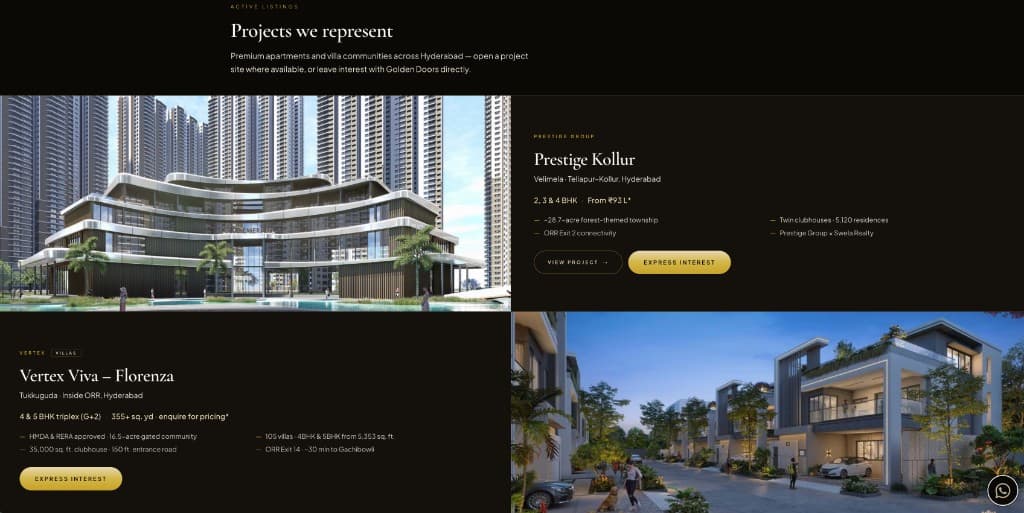
Multiple developer campaigns, one portfolio surface
Each developer campaign has its own identity while sharing the same engineering foundation — separate collateral, pricing, and conversion paths without commissioning another full website build per launch.
Constraints
Constraints
Each campaign required strict isolation: wrong canonical URLs or cross-leaked branding between developers would be a compliance and commercial problem, not a cosmetic one. Content changes needed review control — pricing disclaimers, RERA references, authorized-partner copy — which ruled out a loose CMS without governance. Lead capture had to work reliably for paid traffic without standing up a custom backend for every launch.
The Decision
The Decision
Treat each campaign as a configuration of one platform, not a bespoke build. A configuration-driven page system would let new projects declare which sections appear and in what order — a long Prestige funnel with pricing and floor plans, an urban Godrej rhythm without the same depth, a Golden Doors broker hub routing visitors to live microsites — all from shared section components. Each campaign would ship as its own domain with baked canonical URLs, analytics, and theme, while sharing one maintainable codebase and deployment pipeline.
- One repository
- Multiple project configurations
- Project packs
- Standalone builds
- Docker
- NGINX
- Independent domains
One codebase, many independent deployments
A single repository declares project configurations and packs, builds standalone artifacts per campaign, and routes each through Docker and NGINX to its own domain — reusing engineering without sharing SEO or branding.
Implementation Approach
Implementation Approach
Separate what varies per campaign from what stays shared. Campaign-specific identity — theme, SEO, content, section order, lead tagging — lives in project packs. Shared conversion sections, disclosure patterns, enquiry forms, and metadata infrastructure live once and reuse everywhere. Deployment bakes each campaign into its own production artifact with its own domain routing, so Prestige traffic never inherits Godrej metadata and staging environments stay out of search indexes by default. The goal was not maximum flexibility. It was the minimum architecture that lets the broker say yes to the next developer campaign without commissioning another full website build.
Each campaign declares a section manifest — the ordered set of marketing blocks that compose its homepage funnel. Prestige runs a deep collateral journey through amenities, pricing, floor plans, payments, and documents. Godrej uses a shorter urban campaign shape with different narrative emphasis. Golden Doors operates as a brand hub: portfolio cards route visitors to live microsites rather than collapsing everything under one domain. Every campaign ships to its own public domain with independent search metadata and structured data. Enquiry forms proxy to a lightweight lead pipeline tagged per campaign so the broker can attribute interest correctly. Adding a future project means authoring a new pack, registering it in the build pipeline, and pointing a domain — not rewriting the application.
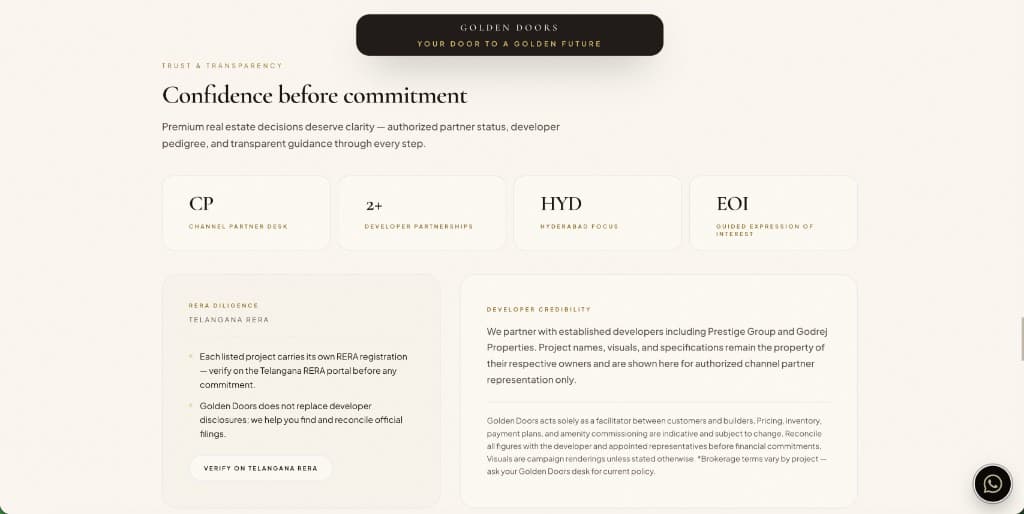
Conversion built on trust before commitment
Reusable campaign sections compose different funnel depths — RERA diligence, developer credibility, and guided expression of interest — so each project can guide visitors from awareness to enquiry without rebuilding the journey.
Outcome
Outcome
What began as a single campaign site evolved into a platform powering multiple live properties: developer microsites for Prestige and Godrej, plus a Golden Doors portfolio hub linking outward to each campaign. New projects register as content and configuration packs rather than new applications. The broker gains faster launches, lower maintenance, consistent partner disclosure, and independent SEO per campaign — without multiplying engineering cost each time a developer relationship goes live.
Lead capture anchored in authorized partner disclosure
The experience is optimized around converting interested visitors into qualified enquiries — with compliant channel-partner copy and persistent contact paths across every campaign.
Lessons Learned
Lessons Learned
Great software is not always about building something new. Sometimes the biggest impact comes from designing a platform that allows many future products to be built faster, more consistently, and with less engineering effort. The evolution from single campaign to reusable engine to broker hub was not feature accumulation — it was architecture becoming more reusable over time, so the client's next launch costs engineering configuration, not reinvention.
What I'd Do Next
What I'd Do Next
The platform is structured for the broker's actual growth curve: more developer campaigns, not thousands of searchable listings. Future projects slot into the same pack-and-manifest model. When a campaign needs a dedicated microsite, it extends the platform; when a smaller project only needs a portfolio presence, the hub can carry it until a full launch is warranted. That is the scalability story — faster launches, reduced duplication, consistent branding, and room to grow without rebuilding the foundation.