
Case Study
Building a Healthcare Collaboration Platform When Generic Networking Wasn't Enough
Healthcare innovation often fails because the right people never meet early enough. Splice — a Heroes of Humanity initiative — was built to connect doctors, engineers, founders, and investors around meaningful MedTech collaboration, not to compete with broad professional networks. The platform shipped as a private beta with a storytelling-first landing experience and a recommendation system designed for professional complementarity.
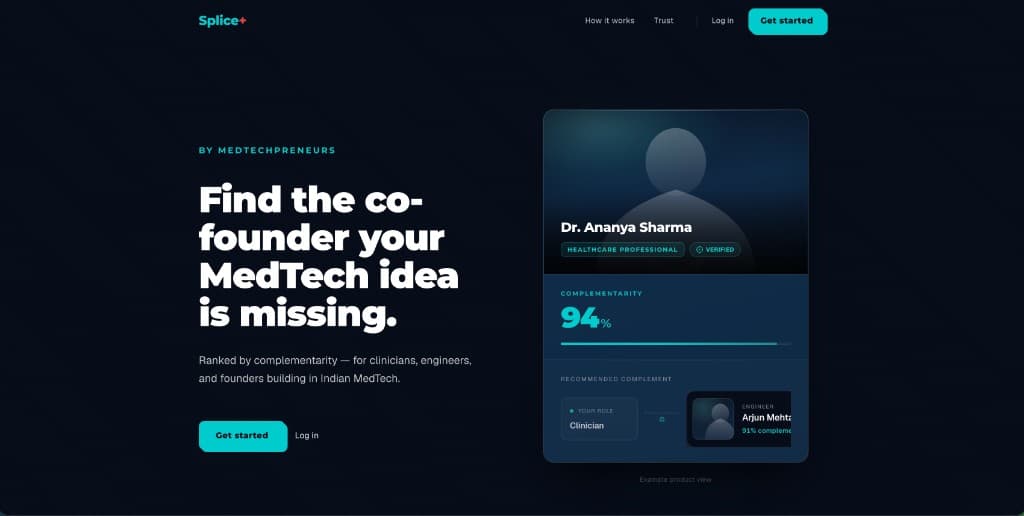
Collaboration introduced through purpose, not features
The landing page leads with the problem Splice exists to solve — finding the co-founder a MedTech idea is missing — rather than a list of platform capabilities.
Project Overview
Project Overview
Splice was created under Heroes of Humanity — the same organizational umbrella as Galactica and Academy — to address a gap generic professional networks do not solve. Healthcare innovation depends on early alignment between people with different expertise. When a clinician and an engineer never connect before product decisions are made, teams often invest heavily in solutions that miss the clinical reality. The platform was not positioned as another LinkedIn. It was a focused collaboration environment for MedTech — where discovery, matching, and messaging exist to increase the probability that meaningful partnerships form before resources are committed.
My Role
My Role
Sole Engineer — architecture, product implementation, landing experience, compatibility logic, and private-beta readiness. Responsible for translating a collaboration vision into a platform where purpose is understandable before a user creates an account.
The Challenge
The Challenge
The problem was specific, not generic. Doctors understand clinical problems. Engineers know how to build. Founders drive execution. Investors understand commercialization. But most networking platforms are broad, noisy, and saturated — making it genuinely difficult to find healthcare-specific collaborators who complement rather than duplicate your skills. The product had to earn trust quickly in a domain where the cost of a wrong match is months of engineering effort aimed at the wrong problem.
Constraints
Constraints
Private beta scope with a small engineering footprint. The product needed to communicate trust and purpose immediately — users would not tolerate a feature-dense interface that failed to explain why they should care. Recommendation quality mattered more than recommendation volume; a high-noise feed would undermine the entire value proposition.
The Decision
The Decision
Design the platform around collaboration outcomes, not profile browsing. The landing experience would tell a story — clinician, builder, founder, investor converging toward better healthcare products — before explaining features. Discovery would prioritize meaningful professional fit through complementarity and intent, not surface-level similarity. Same-city proximity, stated looking-for preferences, startup stage alignment, and role pairing would inform recommendations alongside profile data — increasing the likelihood of useful connections rather than endless scrolling.
Discovery designed for quick, considered evaluation
The interaction model reduces friction so users can assess potential collaborators — with compatibility context visible upfront — without the overhead of a traditional networking workflow.
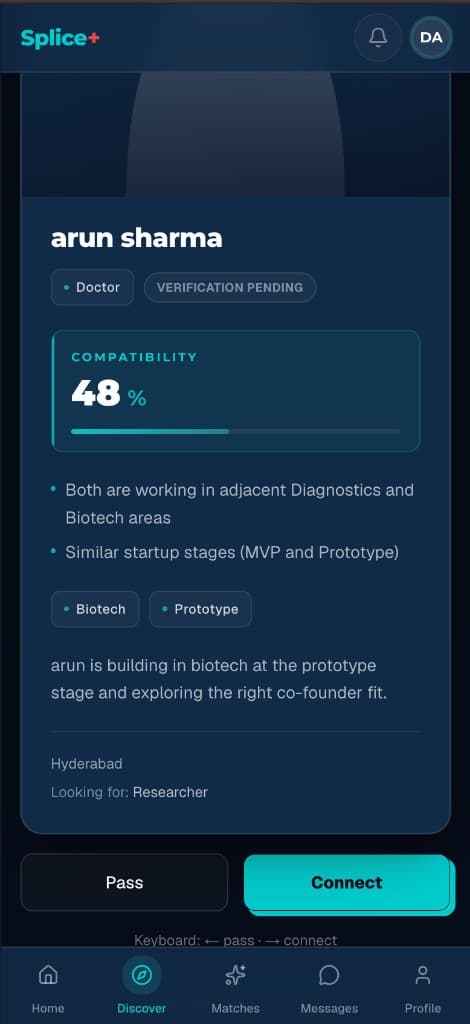
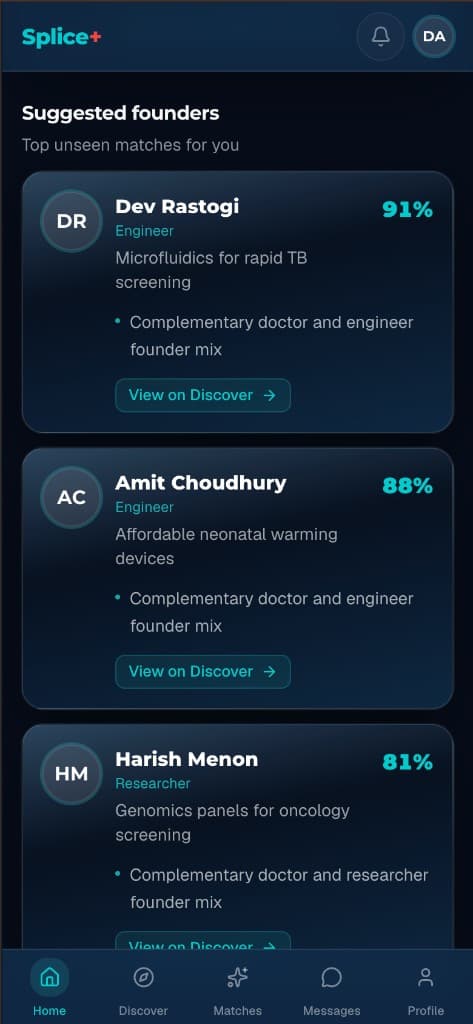
Recommendations weighted toward meaningful fit
Suggested founders surface with context — complementary role mix, building focus, and fit percentage — so recommendations reflect professional compatibility and intent, not profile similarity alone.
Implementation Approach
Implementation Approach
Treat product communication as a first-class engineering problem. The landing page evolved from introducing software to communicating an ecosystem journey — each scene building toward the idea that complementary founders assemble into something stronger together. In the application, the interaction model reduced friction for discovery: users could evaluate potential collaborators quickly without the overhead of a traditional networking workflow. Recommendation logic reflected product thinking, not a generic matching algorithm. Complementary founder roles, building focus, startup stage, stated intent, and location proximity each contributed to compatibility — weighted toward professional fit that would matter in a real co-founding conversation, not profile resemblance.
The landing experience was structured as a narrative sequence — problem, fracture, assembly, outcome — rather than a feature grid. Scroll-driven scenes communicated why isolated expertise fails and how the right combination of stakeholders produces better healthcare products. This was the change the client valued most: the vision became immediately legible. Inside the product, discovery surfaced founders the current user had not yet evaluated, ranked by a compatibility engine that scored role complementarity, building alignment, stage similarity, looking-for preferences, and geographic proximity. Mutual interest created matches and opened messaging — closing the loop from discovery to conversation. Onboarding captured the category and intent data that made recommendations defensible, not arbitrary.
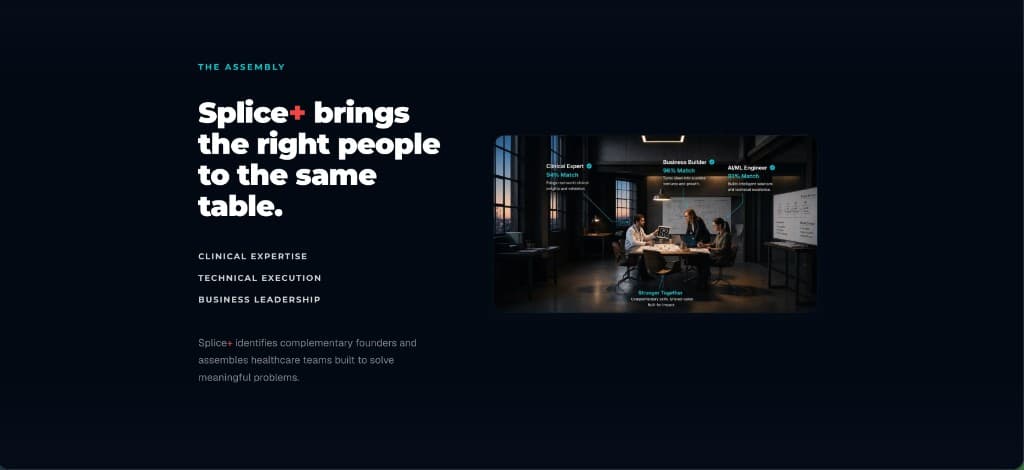
The landing page tells a collaboration story
Scroll-driven scenes communicate how clinical expertise, technical execution, and business leadership converge — making the platform's purpose legible before a user creates an account.
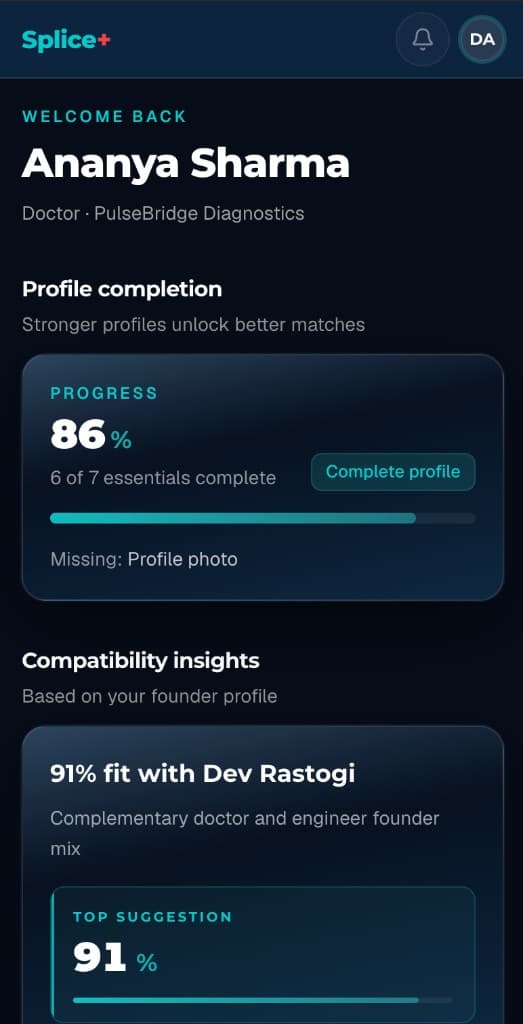
Richer profiles improve collaboration quality
Onboarding captures role, stage, building focus, and intent — the inputs that make recommendations defensible. Profile completion nudges users toward the detail a co-founding conversation actually requires.
Outcome
Outcome
Splice reached private-beta readiness under the MedTechPreneurs brand within a phased delivery cycle. The client responded most strongly to the landing narrative — the clearest articulation of why the platform exists. The product now sits alongside Galactica and Academy within Heroes of Humanity, oriented toward a longer vision: helping the right people collaborate earlier so better medical technology products become more probable.
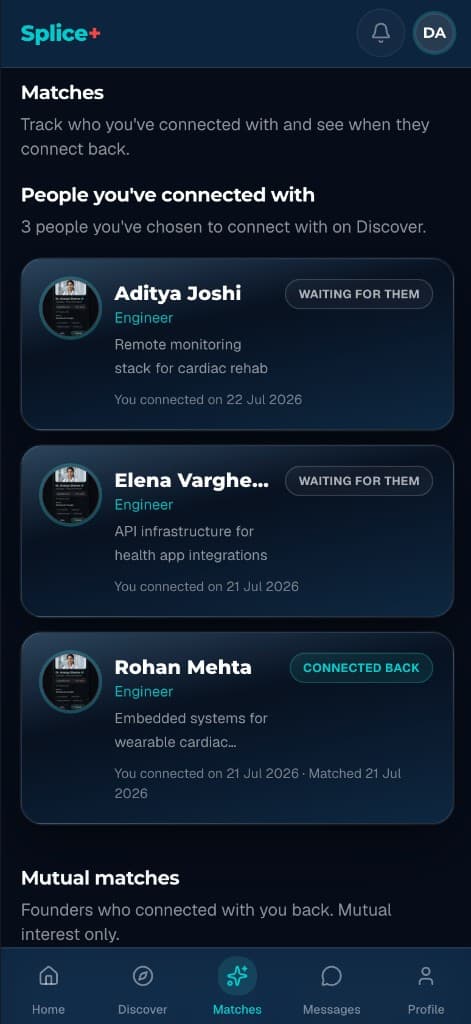
From discovery to mutual interest
The matches view separates pending connections from mutual matches — giving users a clear pipeline from initial interest to a conversation worth having.
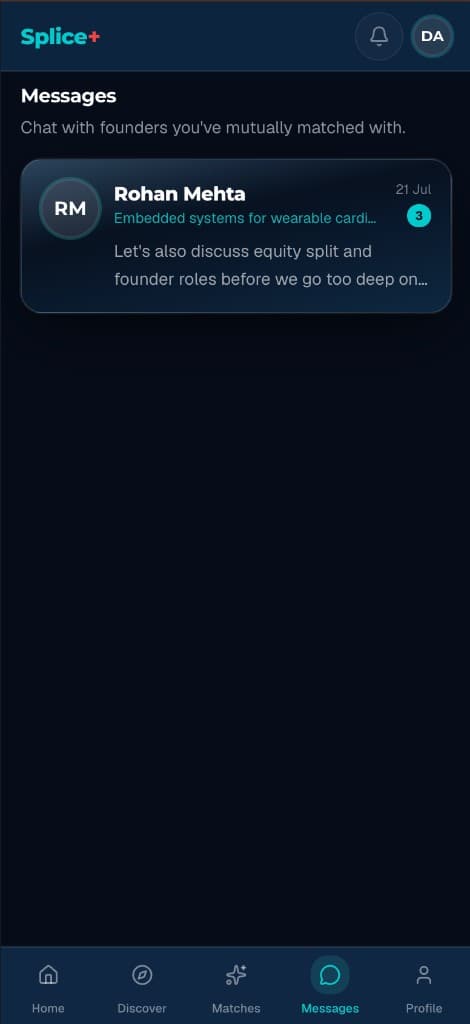
Messaging gated on mutual intent
Conversations open only after both founders connect — keeping outreach focused and reducing the noise that makes broad professional networks unusable for healthcare collaboration.
Lessons Learned
Lessons Learned
I'm proud to have contributed to a platform that helps the right people collaborate before months of engineering effort are invested in solving the wrong problem. The most durable improvement was not a new feature — it was making the platform's purpose immediately understandable. When the landing page tells the story correctly, every downstream engineering decision has clearer justification.
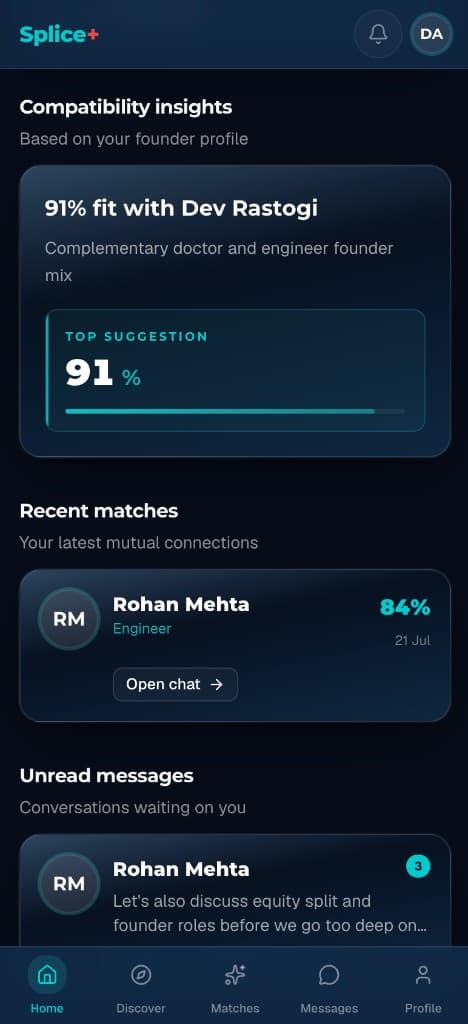
Production-ready across form factors
The authenticated experience — compatibility insights, match activity, and active conversations — ships as a responsive mobile interface, not a desktop prototype with a mobile afterthought.
What I'd Do Next
What I'd Do Next
Splice continues under Heroes of Humanity with room to deepen verification, real-time messaging, and founder resources as the beta cohort grows. The architectural foundation — onboarding-driven intent, complementarity scoring, and match-gated messaging — was built to support that expansion without redefining the product thesis.